Friday, 3 August 2018

Oxford Dictionary vs the Neckbeard

The pejorative use of the term "neckbeard" has found its way into Oxford Dictionary:
1. A growth of hair on a man's neck, especially when regarded as indicative of poor grooming. ‘I can picture myself wearing these clothes a week from now, bits of food caught in my overgrown neckbeard’
1.1 A man who is socially inept and physically unappealing, especially one who has an obsessive interest in computing. ‘I know people expect me to be some sort of balding, overweight neckbeard’
Of course, we can't blame Oxford Dictionary for simply reporting how the term is commonly used, and it's true that the pejorative use is common. But why not also include examples of the term "neckbeard" used neutrally, simply to refer to the beard style? The wiktionary entry is phrased with rather less bias:
1. A style of facial hair wherein the beard is allowed to grow down the chin and is trimmed to an even length over the entirety of the face.
2. (slang) A nerd; a dweeb. 

Neckbeards of Wisconsin

I've recently been browsing the photographic collection of the Wisconsin Historical Society. Lots of great neckbeards in there!


Thursday, 2 August 2018

Walter Booth

Walter Booth (1791-1870) was an American politician from Connecticut who served in the U.S. House of Representatives.


Sunday, 29 July 2018

Types of neckbeards

Neckbeards are commonly confused with the more popular "chin curtain" beard style, where the hair grows partly over the chin. This was worn most famously by Abraham Lincoln, and to this day remains popular among some religious communities such as the Amish. Today I will briefly outline the styles of neckbeard.

(a) I define a pure neckbeard to be where the face is completely shaven, down to below the jawline, and where the hair is allowed to grow all the way around the throat. Two examples of pure neckbeards are Edward Sorin and Horace Greeley.


There are many variations on this basic form:

(b) Neckbeard + sideburns. This is the most common variation. Indeed, the majority of people who wore neckbeards also included sideburns. Examples: Henry David Thoreau, Horatio Seymour, Richard Wagner.


(c) Neckbeard + moustache. Examples: George Henry Lewes, William Empson.


(d) Neckbeard shaved down the middle of the neck. When combined with sideburns, this creates the appearance of two large, prominent sideburns. Examples: Alexander Bain, John Braxton Hicks.


The crucial feature of a neckbeard is that the chin is shaven; this distinguishes neckbeards from chin curtains. Beyond this, there are, as you can see, many styles of neckbeard available. This is important in the context of promoting the neckbeard in society. One of the most common objections I have seen people make against neckbeards is that they indicate a lack of personal grooming. The fact that men with neckbeards often take care to craft their own particular style is a clear refutation of this claim.

As for my own favourite style, I think the best neckbeards are those that attempt to shave as low down the neck as possible, while keeping the beard as big and bushy as possible. William Empson's neckbeard, though not a pure neckbeard due to his moustache, was a striking achievement from this perspective.

John Braxton Hicks

John Braxton Hicks (1823-1897) was a doctor who specialized in obstetrics, and is notable for first describing and investigating the false labour contractions, now named after him as Braxton Hicks contractions, that often occur during pregnancies. Notice that he wore an interesting variation on the neckbeard by shaving down the middle.


Saturday, 21 July 2018

Isaac Green Mitchell

Not much is known about Isaac Green Mitchell (1810-1881). A reverend and pioneer, he was one of the first to settle in what would later become Atlanta, Georgia. Perhaps his greatest claim to fame is that he was the grandfather of Margaret Mitchell, author of Gone With the Wind. He will however always be highly regarded among enthusiasts of the neckbeard.


Friday, 6 July 2018

Debunking a neckbeard myth

One of the most famous neckbeards in history is Henry David Thoreau - indeed, the photo of Thoreau with the neckbeard was what inspired me to grow a neckbeard. For many years, Thoreau's wikipedia page contained the following quote:
Louisa May Alcott reportedly mentioned to Emerson that Thoreau's neckbeard "will most assuredly deflect amorous advances and preserve the man's virtue in perpetuity."
This is often cited online whenever the topic of neckbeards as a beard style comes up. However, in her excellent article How to (try to) lie with Wikipedia, Jessica West thoroughly debunks this quote. It is an invention, one of the many cases where a minor hoax slipped past the Wikipedia editors.

But what did people actually think of Thoreau's neckbeard? Unsurprisingly there is very little information about this available, but I did come across an interesting quote from the journal of Franklin B. Sanborn (from this page):
He looks, too, like Emerson - coarser, but with something of that serenity - and - sagacity which E - has. Thoreau looks eminently sagacious - like a sort of wise wild beast. He dresses plainly, wears a beard on his throat, and has a brown complexion
So it seems that Sanborn, at least, didn't view Thoreau's neckbeard as being especially tasteless: he mentions it just like you might mention a moustache or a hat. This isn't surprising given that in 19th century America the neckbeard was, if not a popular beard style, at least not almost unheard of as it is today.

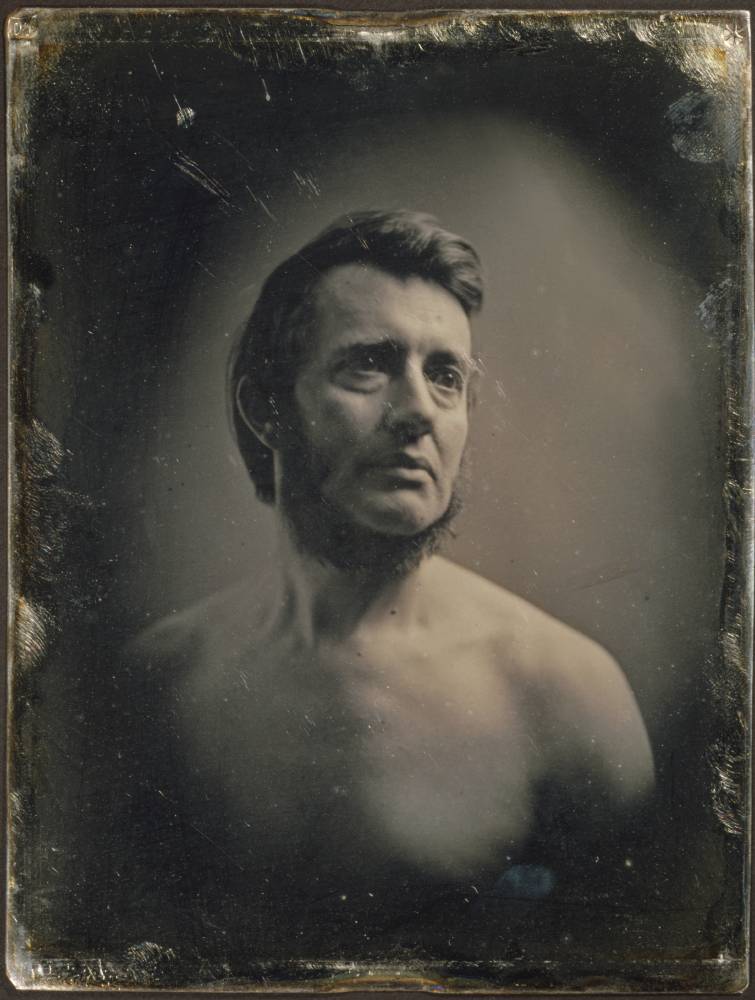
Albert Southworth

Albert Southworth (1811–1894) was an American photographer specializing in daguerreotypy who Southworth & Hawes photographic firm together with J.J. Hawes. They were among the most influential early American photographers, known for producing highly realistic, finely-detailed photographs, with inventive use of light and shade. Two self-portraits of Southworth are shown below.


Saturday, 16 June 2018

Neckbeards across the animal kingdom

Here's a quote that appears on the back cover of Thomas Gowing's book "Philosophy of Beards":

Take two drawings of the head of a lion, one with and the other without the mane. You will see how much of the majesty of the king of the woods, as well as that of the lord of the earth, dwells in this free-flowing appendage.

Gowing's book was mainly concerned with full beards rather than neckbeards, but this quote got me thinking. The lion's mane isn't on the lion's chin. It's not on the lion's cheeks. Clearly, the lion has a neckbeard.


Lions aren't the only animals with neckbeard. The style is also found in many species of goat.


The bearded vulture has a small neckbeard. This bird is especially interesting since it's the only known animal whose diet consists almost exclusively of bone. That's pretty metal!


Finally, the pogona or bearded dragon is an interesting case. Although it doesn't have neck hair, the underside of its throat has spiny scales that expand and change colour when it feels threatened, very strongly resembling the neckbeard.


Saturday, 9 June 2018

Moondyne Joe

Moondyne Joe (1826-1900) was a criminal famous for escaping numerous times from prison. Born in Cornwall, Joe migrated to Wales where he was arrested for burglary and stealing. He served time in various English prisons but was transported to Australia in 1852. Joe continued his criminal activities in Australia, but no prison seemed able to hold him; he even escaped from a bespoke "escape-proof cell" built just for him after several successful escapes. Unfortunately I can't find any high-quality photos of Moondyne Joe, but his remarkable neckbeard is still visible here.